FAQ & Structured Content That Wins AI Answer Boxes
AI engines quote question-led, concise, topically deep content. Learn the content patterns that get concrete coating answers cited in AI answer boxes.
We frequently see concrete coatings contractors struggle with a massive shift in how homeowners find services online.
A 2026 report from BrightEdge shows that Google AI Overviews now appear on roughly 50% of US queries.
This data from Google means your potential customers often get their answers without clicking a single blue link. Traditional optimization is becoming less effective on its own. Let’s look at the exact structured content for ai search that wins these top placements, and then review how our AEO service implements these formats for local installers.
Why Structure Beats Volume
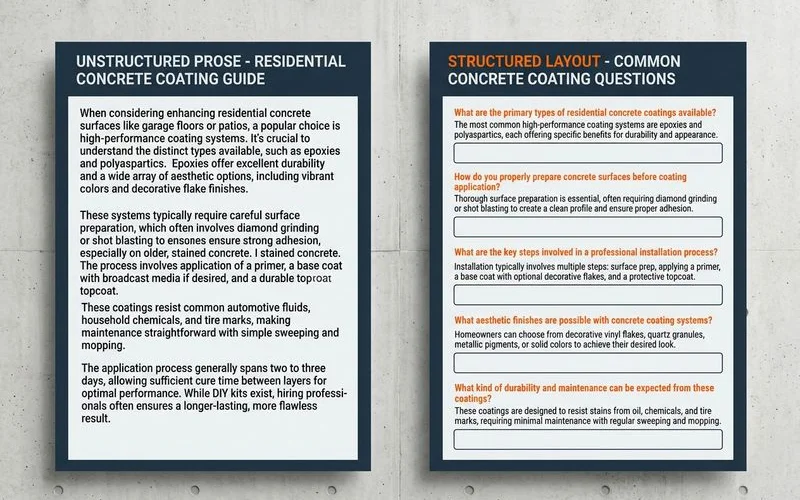
For AI answer engines, clear structure always matters more than sheer word count. These systems use Retrieval-Augmented Generation to extract specific facts, so they prioritize short, clearly defined answers over long blocks of text. A 700-word page broken into distinct question blocks will consistently outperform a 2,000-word unstructured essay.
We rely on this principle to secure top visibility for our clients. According to 2026 data from Search Atlas, pages utilizing clear FAQPage schema appear in AI Overviews 3.2 times more often than unstructured pages. You need to provide data in a format the machine can easily digest.
Let’s compare the two approaches side by side to see the difference.
| Content Approach | AI Engine Extraction | Typical Result |
|---|---|---|
| 1,500-word wall of text | Struggles to parse facts | Ignored by AI Overviews |
| 700-word structured Q&A | Cleanly extracts answers | Quoted repeatedly |
The Question-Led Content Pattern
The template that wins AI citations pairs a specific user question in the heading with a direct answer in the first sentence. The second and third sentences add essential qualifiers, while the following sentences provide supporting context. This exact framework gives generative models the clean extraction format they need.
We build every service page using this exact sequence. A 2026 study from the Pew Research Center found that 60% of question-style queries trigger an AI Overview. Formatting your content this way aligns perfectly with what the engine actively seeks.
Example structure:
H2: How Much Does a Polyaspartic Garage Floor Cost in Tampa? Polyaspartic garage floor coating in Tampa typically runs $5 to $12 per square foot installed, or $2,500 to $7,000 for a standard two-car garage. Price depends on floor size, concrete condition, and the specific polyaspartic system chosen. Basic single-color systems land at the lower end, while decorative flake or metallic systems land at the higher end…
That first sentence is what Google’s AI Overview will quote. That is the exact placement you are competing for today.
What AI Answer Engines Don’t Quote
AI systems will not quote content that buries the answer, uses vague marketing language, or lacks clear HTML heading structure. These algorithms require immediate, factual responses located right at the beginning of a paragraph. A recent 2026 Seer Interactive study shows that uncited brands receive less than a third of the traffic they used to get, making proper formatting crucial.
We constantly audit local contractor sites and find the same formatting errors burying great information. Here is a breakdown of what actively prevents your content from being cited.
- Buried Answers: Long paragraphs where the core fact is hidden in the fourth sentence.
- Vague Marketing Claims: Using subjective headlines like “Best Garage Floor Coatings” instead of clear questions like “What Is the Best Garage Floor Coating?”
- Fluff Over Substance: Pages stuffed with primary keywords but completely lacking specific pricing, timelines, or material data.
- Poor HTML Structure: Pages without clear H2 and H3 tags leave the AI engine unable to identify quotable segments.
Concrete Coating FAQ Templates
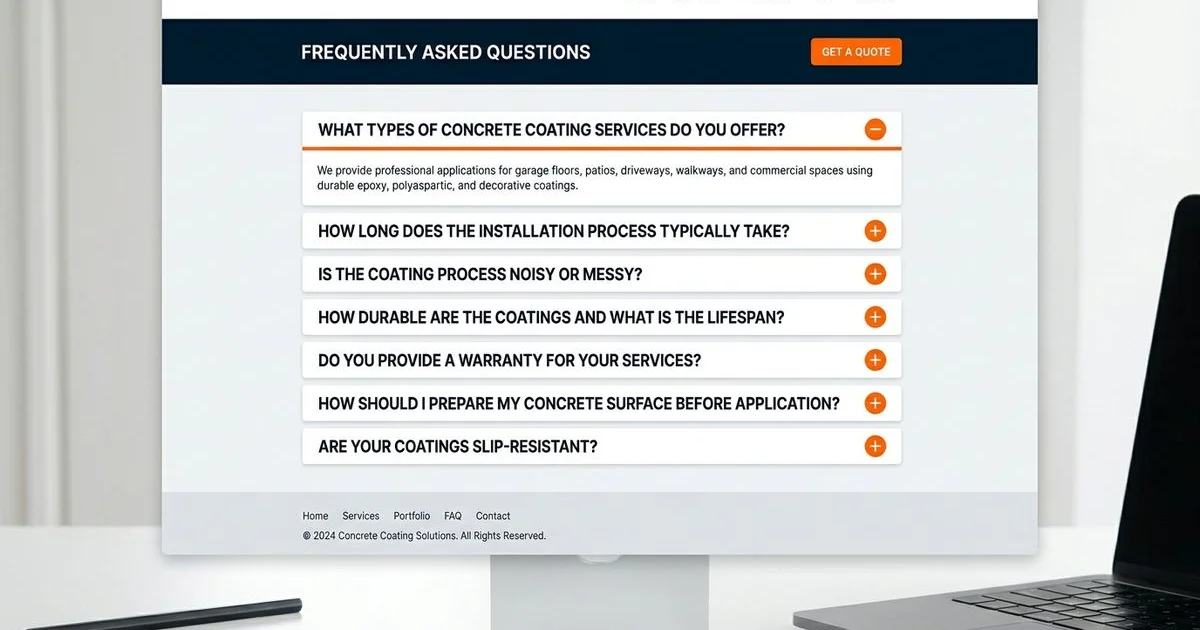
Every concrete coating service page needs an FAQ section addressing the top 5 to 8 buying questions marked up with FAQPage schema. This specific JSON-LD markup acts as a translation layer, making your answers instantly readable to AI platforms. Google removed the visual FAQ drop-downs from search results in May 2026, but the underlying schema remains essential for machine readability.
We strictly enforce this markup rule for every epoxy and polyaspartic page. Fast Frigate Digital Marketing recently confirmed that structured data gives large language models the exact entity relationships they need to bypass complex language parsing. Executing strong faq content ai strategies requires marking up each pair properly, and our companion guide on schema markup and entity optimization for concrete coating sites walks through the exact JSON-LD that powers it.
For a polyaspartic garage floor page, your template must include:
- How much does polyaspartic garage floor coating cost?
- How long does polyaspartic take to cure?
- Is polyaspartic better than water-based epoxy?
- How long does a polyaspartic garage floor coating last?
- Do you offer a warranty on polyaspartic coating?
- Can polyaspartic be installed in hot weather?
Topical Depth vs Padding
Topical depth means answering every practical question a buyer has, while padding simply adds words to hit an arbitrary length. AI engines actively reward comprehensive answers about costs, warranties, and risks, but they ignore fluffed-up text. A 2026 Ahrefs study found that highly detailed pages average 10 AI citations, compared to just 2.4 citations for thin pages.
We prioritize real numbers and verifiable facts over empty adjectives. Homeowners need to know that polyaspartic cures in 24 hours, whereas traditional epoxy takes 3 to 7 days. These concrete comparisons build trust and signal authority to the search algorithms.
Consider this breakdown of depth versus padding.
| Content Strategy | Focus Area | Value to Reader |
|---|---|---|
| Topical Depth | Concrete prep, cure times, warranties | High value, decision-driven |
| Word Padding | Repetitive keyword usage, generic history | Low value, frustrating |
Pattern Recognition
A missed AI citation opportunity occurs whenever an answer engine displays a coating response without linking to your comprehensive page. You can usually fix this gap simply by restructuring your existing text into a direct question-and-answer format. This is often the fastest answer box optimization win available because it requires no new writing.
We monitor search results daily to spot these specific gaps for concrete professionals.
Every time you see a competitor cited for a question you already answered in a buried paragraph, you have found an immediate optimization target.
Start by auditing your top three service pages today to build the structured content for ai search that drives real revenue.
Common Questions
What content format wins AI answer boxes?
How long should answer blocks be?
Should I use FAQ schema on every page?
Related Guides
AEO vs. Traditional SEO for Concrete Contractors
AEO and SEO have different goals but compound together. A side-by-side of tactics, results, and sequencing so concrete contractors know why they need both.
Read guide →How ChatGPT and AI Overviews Surface Concrete Contractors
How LLMs and AI Overviews pick which concrete contractors to cite — the role of entities, citations, and what your site needs to be chosen.
Read guide →Is Your Concrete Website Ready for AI Search?
Run this readiness checklist to see whether your concrete coating site is set up for AI search — common gaps, a quick self-audit, and what a full AEO audit adds.
Read guide →Schema Markup & Entity Optimization for Concrete Coating Sites
LocalBusiness and Service schema, entity consistency, and FAQ markup make a concrete coating site AI-readable. Here's the technical work that feeds answer engines.
Read guide →
Ready to talk about Answer Engine Optimization (AEO)?
See how answer engine optimization (aeo) could work for your business — free audit, no long-term contracts.