AEO vs. Traditional SEO for Concrete Contractors
AEO and SEO have different goals but compound together. A side-by-side of tactics, results, and sequencing so concrete contractors know why they need both.
A massive shift recently transformed how US homeowners look for flooring contractors. You know how frustrating it is when your website traffic drops even though your rankings stay flat.
The data tells the real story. Roughly 69% of online searches now end without a single click to a traditional website. AI systems intercept those queries and answer customer questions directly on the results page.
This is exactly why understanding the answer engine optimization vs seo debate is absolutely mandatory.
Our company, SEO for Concrete Coatings, was established to deliver high-quality digital marketing solutions that concrete professionals can depend on for long-term growth. The goal today is to walk you through exactly how these two strategies differ. You will see how they overlap, where they diverge, and the exact steps you can take to capture both types of search traffic.
For a quick look at agency execution, you can review our AEO service and our SEO service. Let’s look at the hard data and explore a few practical ways to respond.
The Core Difference
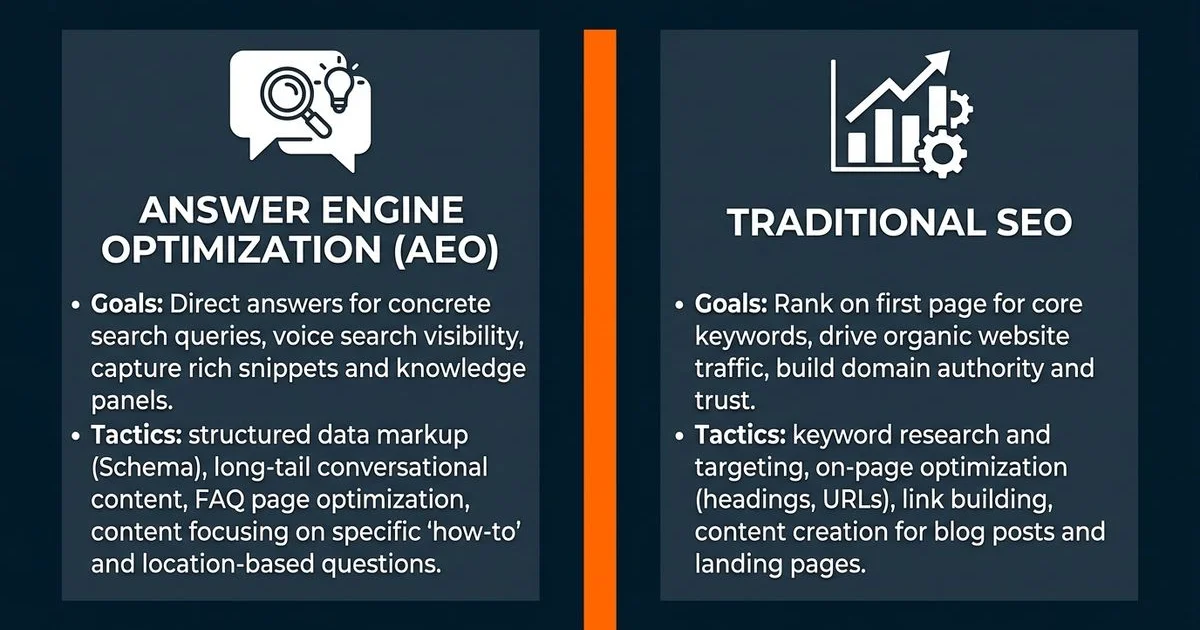
Our team defines the core aeo vs seo difference simply. Traditional optimization gets your website into the top 10 blue links, while answer optimization makes your business the trusted source ChatGPT, Perplexity, or Gemini quotes. If the term is new to you, our primer on what Answer Engine Optimization is for contractors breaks the concept down in plain language before you compare the two.
According to Q2 2026 market data from First Page Sage, Google still holds about 77% of global digital queries, but ChatGPT has rapidly captured nearly 18% of the market.
We see concrete contractors missing out on high-intent leads because they focus strictly on traditional ranking metrics. The harsh reality is that AI platforms prioritize verifiable data and concise formatting over long paragraphs. Both channels matter, both are earned, and both benefit from the same underlying signals, though they are weighted differently.
Side-by-Side Comparison
Both search channels require completely different daily execution tactics and success metrics. We built a straightforward comparison so you can see exactly where your marketing dollars go for each approach. This breakdown highlights the specific variations in timelines, costs, and ultimate goals.
| Dimension | Traditional SEO | Answer Engine Optimization |
|---|---|---|
| Goal | Rank in results | Get cited in AI answers |
| Primary surface | Google map pack + organic links | ChatGPT, AI Overviews, Perplexity |
| Success metric | Rankings, organic clicks, leads | Citation frequency, AI-referred traffic |
| Content pattern | Depth + keyword optimization | Question-led + concise direct answers |
| Schema role | Optional (helps rich results) | Foundational (drives citation eligibility) |
| Timeline | 3 to 6 months to traction | 30 to 90 days for schema, 3 to 6 months for content |
| Compounds over time | Yes | Yes, and often faster than SEO |
| Cost | Retainer-based | Retainer-based (often bundled) |
Our experience shows that tracking the right success metrics presents the biggest hurdle for local pavers and coating specialists. Ranking reports do not tell you if ChatGPT recommended your decorative concrete services to a local homeowner. You need specialized tracking to measure those specific AI citations and brand mentions.
Where They Overlap
Both search disciplines share the exact same underlying technical foundation. A clean site architecture and strong entity signals represent non-negotiable requirements before either strategy can generate local leads.
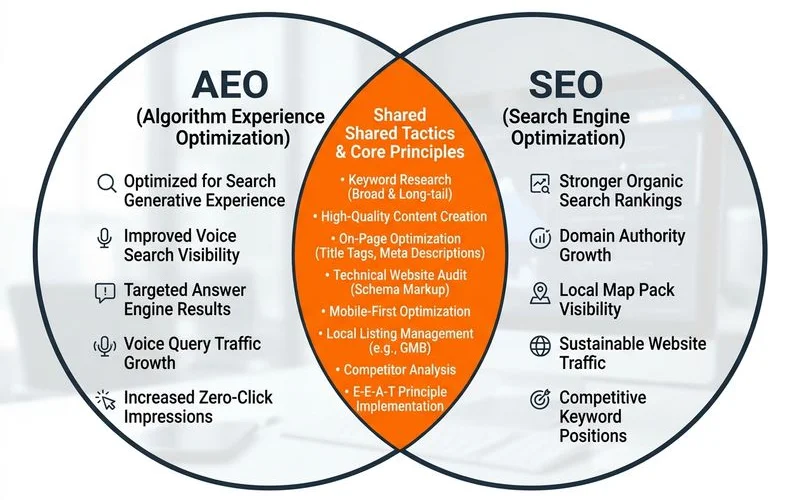
We know that a well-structured website makes life easier for both Google crawlers and AI bots. Here is the shared groundwork you must have in place:
- Clean site architecture and internal linking
- Schema markup (LocalBusiness, Service, FAQ)
- Consistent NAP (Name, Address, Phone) and entity signals
- Author bios and E-E-A-T signals
- High-quality content with clear structure
Recent 2026 data from a Princeton GEO study found that adding verifiable expert quotes to your content boosts your AI visibility by roughly 41%. That exact same credibility signal also builds the trust Google needs to rank you in the local map pack. This explains why most coating contractors run both together, because 60% of the foundational work benefits both channels simultaneously.
Where They Diverge
When analyzing the aeo seo difference in daily execution, the required tactics diverge significantly. We separate these workflows because what satisfies a Google algorithm does not necessarily satisfy an AI language model. The algorithms simply look for different structural cues.
Traditional SEO Tactics
Classic optimization focuses heavily on building website authority and matching user intent through keyword mapping. You will typically see your marketing team execute these specific tactics:
- Long-tail keyword targeting for ranking
- Local map-pack optimization tactics
- Backlink acquisition for domain authority
- Traditional metadata (title, meta description) tuning
AEO-Specific Tactics
Answer engines require information structured for immediate, effortless extraction. Our approach involves building a coherent knowledge system rather than just publishing generic blog posts. The required tasks look a bit different here:
- FAQ schema on service pages
- Question-led H2/H3 restructuring
- Author entity graph building
- AI-citation surface monitoring
- Answer-first content pattern enforcement
A crucial insider tip from recent US local SEO forums highlights the massive power of unstructured data. Getting your concrete business mentioned naturally in neighborhood subreddits or local community blogs provides a massive boost to your AI citations. Modern AI models scan these community discussions to see who real people recommend in your specific city, which carries more weight for them than a traditional directory backlink.
Sequencing
If you can only afford one channel for the first three months, you must start with the classic search approach. The initial foundation work directly benefits both platforms and gets your phone ringing much sooner.
We strongly recommend layering in dedicated AEO work starting in month four or when your budget allows. This later phase includes implementing targeted FAQ schema, question-led content restructuring, and careful citation monitoring. Because complex schema takes 30 to 90 days for AI systems to fully parse and trust, you want that technical bedrock settled first.
If you have the budget to run both from day one, you should absolutely execute them together. The combined retainer is usually not much more than a standalone campaign because you unlock two major efficiencies:
- A shared technical foundation that never gets duplicated.
- Two powerful lead generation engines built on the exact same structural framework.
The Compounding Case
The absolute best reason to run both campaigns is that their results actively compound over time. Strong traditional optimization gives AI engines the exact authority signals they need to trust your business as a valid source.
We see strong answer optimization driving citation-referred traffic that generates highly qualified, ready-to-buy leads. Neither channel acts as a substitute for the other. Both together capture the full surface of a modern US consumer search, from traditional map results right down to personalized Gemini answers.
Data shows that 89% of commercial buyers and proactive homeowners now use generative AI during their purchase research. The coating contractors who invest in both channels starting in 2026 will build a durable, long-term visibility advantage. You will secure several key benefits:
- Dominance in traditional local map packs.
- Frequent citations in personalized AI answers.
- A massive edge over competitors waiting to see how AI search shakes out.
Our final piece of advice on the aeo vs seo decision is to evaluate your current digital footprint today. Check your existing site for foundational schema and start planning your transition to an answer-first content model to win both sides of the search landscape.
Common Questions
Should I do SEO or AEO first?
Does AEO replace SEO?
Can one campaign cover both?
Related Guides
FAQ & Structured Content That Wins AI Answer Boxes
AI engines quote question-led, concise, topically deep content. Learn the content patterns that get concrete coating answers cited in AI answer boxes.
Read guide →How ChatGPT and AI Overviews Surface Concrete Contractors
How LLMs and AI Overviews pick which concrete contractors to cite — the role of entities, citations, and what your site needs to be chosen.
Read guide →Is Your Concrete Website Ready for AI Search?
Run this readiness checklist to see whether your concrete coating site is set up for AI search — common gaps, a quick self-audit, and what a full AEO audit adds.
Read guide →Schema Markup & Entity Optimization for Concrete Coating Sites
LocalBusiness and Service schema, entity consistency, and FAQ markup make a concrete coating site AI-readable. Here's the technical work that feeds answer engines.
Read guide →
Ready to talk about Answer Engine Optimization (AEO)?
See how answer engine optimization (aeo) could work for your business — free audit, no long-term contracts.