How to Get Concrete Coating Leads With SEO
SEO turns local search into a durable lead source for concrete coating contractors. Here's how organic rankings and the map pack generate qualified coating leads.

The Short Answer
You already know the decorative concrete market is booming in the US, with projections hitting $24.3 billion by 2028.
We have seen that capturing those $2,500 to $8,000 residential garage jobs requires a smarter strategy than buying shared leads on Angi. If you are wondering how to get concrete coating leads, the most reliable strategy relies on two pillars:
- Ranking in the Google local map pack for the exact queries your buyers type.
- Building service-area pages that answer their specific coating questions.
Paid ads produce calls while your budget is active.
Our team focuses on SEO because it produces results for years after the initial work is done. For a complete breakdown of this strategy, review our concrete coatings SEO service. This guide walks through the exact mechanics you need to understand.
How SEO Actually Generates Coating Leads
Homeowners and facility managers do not just search for generic contractors anymore. They type highly specific phrases into Google when they are ready to hire. We analyze US search data using tools like Ahrefs to identify exactly what your local market wants.
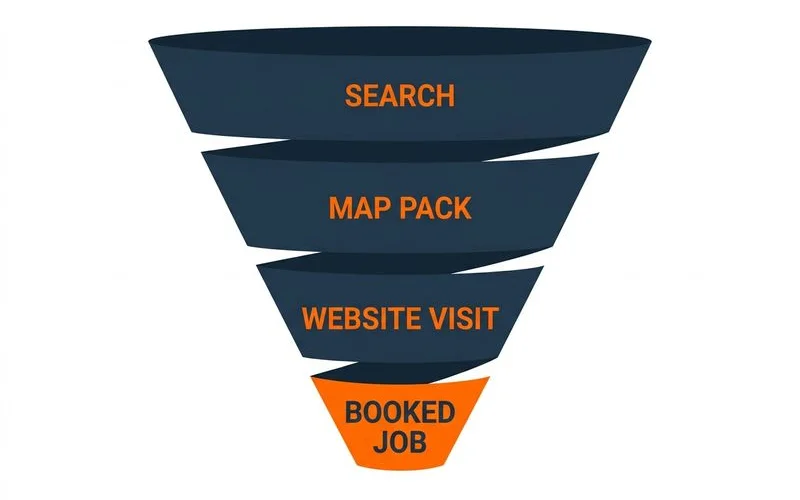
Google Maps captures roughly 70% of local clicks for service searches. If your website does not align with specific buyer intent, those clicks go straight to your competitors.
High-Value Query Patterns
Search intent for concrete coating work breaks down into a small number of high-value query patterns:
- Local proximity queries: Phrases like “concrete coating [city]” or “epoxy garage floor near me” capture immediate local demand.
- Service-specific queries: Buyers search for exact solutions, such as “polyaspartic garage floor” or “polished concrete floors commercial.”
- Comparison queries: Educated prospects often search “polyaspartic vs epoxy coating” before making a final decision.
- Problem-driven queries: Homeowners dealing with failed DIY kits search for “cracked garage floor coating” or a “peeling epoxy fix.”
We build a dedicated page for every single one of these patterns. A generic services page trying to rank for all of them will rank for none.
Concrete contractors who dominate local search have a page that matches each significant query pattern, tuned to the exact language their buyers use.
Lead Flow vs One-Off Ad Spend
The clearest way to see why SEO wins for concrete contractors is to compare cost-per-lead over time. Paid ads deliver a fixed cost per lead that stays roughly flat over the years. You pay the same amount for lead number one as you pay for lead ten thousand, because every single click goes through the Google auction.
We track these metrics closely for US contractors. Recent 2026 data shows that Google Ads cost per lead for concrete searches often runs $50 to $150 in major metros.
The Long-Term ROI Advantage
SEO has an upfront cost that generates a growing stream of leads month after month. This organic momentum drops the effective cost per lead sharply after the first six months. Industry benchmarks show that organic leads eventually amortize down to roughly $35 each, delivering a 400% to 450% long-term return on investment. To budget for that upfront investment, see our breakdown of how much concrete contractor SEO costs and how retainers map to expected lead volume.
| Strategy | Primary Benefit | Average Cost Per Lead (2026) |
|---|---|---|
| Google Ads (PPC) | Immediate visibility and instant calls. | $50 to $150 per lead |
| Local SEO | Compounding growth and long-term dominance. | $35 per lead (amortized) |
We do not think paid ads are wrong for your business. Ads are the right choice when you need lead flow this week to keep your installation calendar full.
SEO is the right choice when you want steady lead flow in three years without a massive monthly ad bill. A balanced strategy often uses paid ads to test which keywords convert best, while building permanent SEO pages to replace that ad spend over time.
What a Coatings SEO Campaign Looks Like
A successful campaign requires a methodical approach rather than random tactics. You cannot just build a website and hope homeowners find it. We organize our execution into four distinct phases to ensure maximum visibility and conversion.
The Four Core Phases
- Foundation month: Your Google Business Profile gets fully optimized to capture Maps traffic. Local citations are cleaned up across platforms like Yelp and Houzz, technical SEO fixes are applied, and LocalBusiness schema markup is added site-wide.
- Content phase: Service pages are built or rewritten around real coating search intent, like highlighting popular one-day polyaspartic installations. Service-area pages are created for each meaningful neighborhood, and specific FAQ blocks are added to address common customer concerns.
- Authority phase: Local citation building expands your digital footprint. Editorial link outreach builds domain authority, and a review generation cadence is established by integrating your Google profile with CRM tools like Jobber or ServiceTitan.
- Compounding phase: Content is regularly refreshed to maintain rankings. New queries are targeted based on search trends, and the campaign expands into adjacent service areas to capture a wider audience.
We run this exact sequence for every client. The strategy is carefully calibrated to match your starting authority and the specific market competition in your region.
Setting the right expectations is crucial for a healthy marketing partnership. The table below outlines what a typical six-month progression looks like.
| Campaign Stage | Primary Focus | Expected Lead Impact |
|---|---|---|
| Months 1 to 2 | Technical foundation and Google Business Profile optimization. | Minimal organic leads. Focus is on fixing structural errors. |
| Months 3 to 4 | Publishing targeted service pages and building local authority. | Initial maps ranking improvements and a slow trickle of targeted calls. |
| Months 5 to 6+ | Compounding authority, acquiring backlinks, and gathering reviews. | Consistent, lower-cost organic leads replacing expensive paid ad spend. |
This structured approach ensures your digital presence grows steadily. You will start capturing more of those high-value garage and commercial flooring projects as your local rankings climb.
Getting Started
The US decorative concrete market is expanding rapidly right now. Contractors who delay their digital strategy will inevitably lose market share to competitors who secure those top Google rankings today.
We want to help you capture that growing demand and get more coating jobs. Book a free audit to uncover:
- The exact local queries you are currently missing.
- The specific technical gaps holding your website back.
There is no obligation to sign a contract.
The insights you gain from this diagnostic are highly useful whether or not you decide to work with our team.
Common Questions
How long before SEO produces coating leads?
Is SEO better than paid ads for coating leads?
What makes a coating lead qualified?
Related Guides
Concrete Leveling & Slab-Jacking SEO: Capturing Sibling-Trade Keywords
If you level slabs as well as coat them, sibling-trade keywords like 'sunken driveway repair' expand your footprint. Here's how to structure those pages.
Read guide →How Long Does Concrete Contractor SEO Take to Work?
Most concrete contractors see SEO traction in 3-6 months. Here's a phase-by-phase timeline of what moves early, what takes longer, and what speeds it up.
Read guide →How Much Does Concrete Contractor SEO Cost?
Concrete SEO is usually a monthly retainer starting near $1,500. See what drives cost, retainer vs. project pricing, and how to frame it against cost-per-lead.
Read guide →Local SEO for Concrete & Epoxy Contractors, Explained
How local SEO works for concrete and epoxy contractors — Google Business Profile, the map pack, service-area pages, and review signals that win install work.
Read guide →
Ready to talk about SEO for Concrete Coatings?
See how seo for concrete coatings could work for your business — free audit, no long-term contracts.